

PAS-225X Active Antenna Distribution System Setup Guide
The PAS-225X, an active antenna distribution system, is designed to deliver optimal wireless audio performance for multiple wireless systems operating simultaneously. This guide will walk you through proper setup and usage to ensure stable, clear, and reliable audio performance.
Single System Setup
Before setting up the PAS-225X, please ensure that the operating frequency bands of your wireless microphone systems fall within the supported range of 400–950 MHz.
Splitter Installation
To place the PAS-225X on a desk or flat surface, attach the included adhesive rubber feet to the bottom of the unit for stable positioning.
For rack mounting, ensure you are using a standard 19-inch rack and secure the metal brackets using appropriate screws (not included).
Coaxial Cabling
The PAS-225X features 8 RF output jacks, allowing connection of up to 8 wireless microphone receiver antenna inputs.
Use the included short BNC cables (21 in) to connect the left and right RF outputs of the distributor to the corresponding antenna jacks on each receiver.
It is recommended to divide receivers into two groups and connect them separately to Band A and Band B RF outputs.
Power Supply
The PAS-225X includes four 12V DC power outputs to supply power to up to four wireless receivers. Four DC power cables are included to help maintain a clean and organized setup.
Remote-Mounted Antennas
Use longer BNC cables (9.5 ft) to connect each directional antenna paddle to the ANT input jacks on the splitter.
Antenna Orientation
Directional antennas are most sensitive to signals received from the front. Position the antenna paddles at a higher elevation and aim them directly toward the operating microphones to maintain clear line-of-sight and reduce interference.
After completing all connections, power on the PAS-225X and wireless receivers. Pair each microphone with its corresponding receiver and adjust the gain settings (up to 8 dB with 16 steps). Perform a sound check before live use.
Note:
When using a single PAS-225X, the cascade ports allow you to connect an additional pair of antennas from a wireless receiver if needed.
Multiple Systems Setup
If you need to connect more than 10 antenna inputs (typically more than five dual-channel wireless receivers), multiple PAS-225X units can be connected in parallel using the cascade ports.
Use two 21-inch BNC cables to link the cascade ports of one splitter to the ANT inputs of another. This configuration allows multiple splitters to share the same pair of directional antenna paddles.
Important:
Using too many wireless channels simultaneously may overcrowd the RF environment, leading to signal degradation and instability. For best performance, it is recommended to use no more than three PAS-225X units at the same time.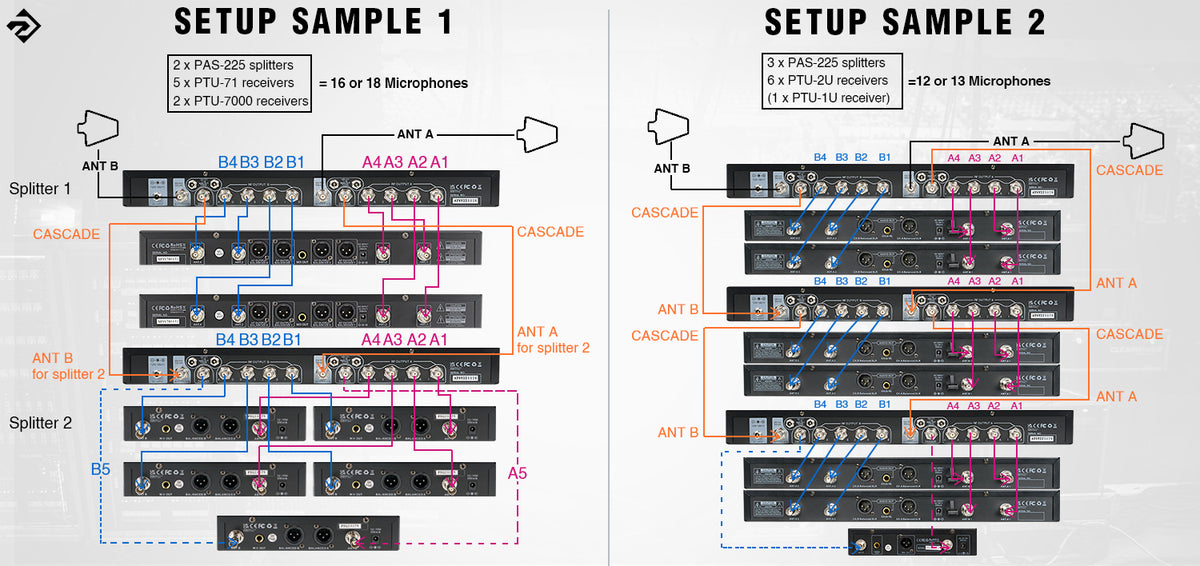
Gain Setting
When using the included BNC cables, expect approximately 0.7 dB signal loss during transmission. Additional signal loss may occur due to antenna distance and multipath interference.
To compensate, adjust the gain setting (recommended above 3 dB) to strengthen signal range and clarity. Avoid excessive gain, as it may introduce noise, dropouts, and unwanted RF interference. Proper gain adjustment ensures a better signal-to-noise ratio (SNR) and cleaner audio performance.
Best Practices & Placement Tips
-
Keep at least 60 cm (3 ft) of clear space around each antenna paddle
-
Remove barriers between antenna paddles
-
Avoid large metal objects in the signal path
-
Minimize people or obstructions between transmitters and antennas
-
Keep antennas away from excessive personal electronics such as phones and laptops
Antenna Distributor vs Antenna Combiner
Many users confuse antenna distributors with antenna combiners, so it’s important to understand the difference.
In a wireless microphone system, microphones transmit RF signals to receivers. The PAS-225X antenna distribution system collects these signals via antenna paddles and evenly distributes them to multiple receivers.
In contrast, an antenna combiner works in reverse. It gathers RF signals from multiple IEM transmitters and sends them through a single antenna to bodypack receivers. While similar in concept, the signal direction and application are opposite.
The PAS-225X is designed specifically for wireless microphone systems, not IEM systems.
We plan to release a compatible antenna combiner system for our IEM lineup in the near future. Follow our socials to stay updated on upcoming releases.


